 Actor
Actor
M. G. Ramachandran (MGR) Biography, Age, Net Worth, Height, Movies & Facts
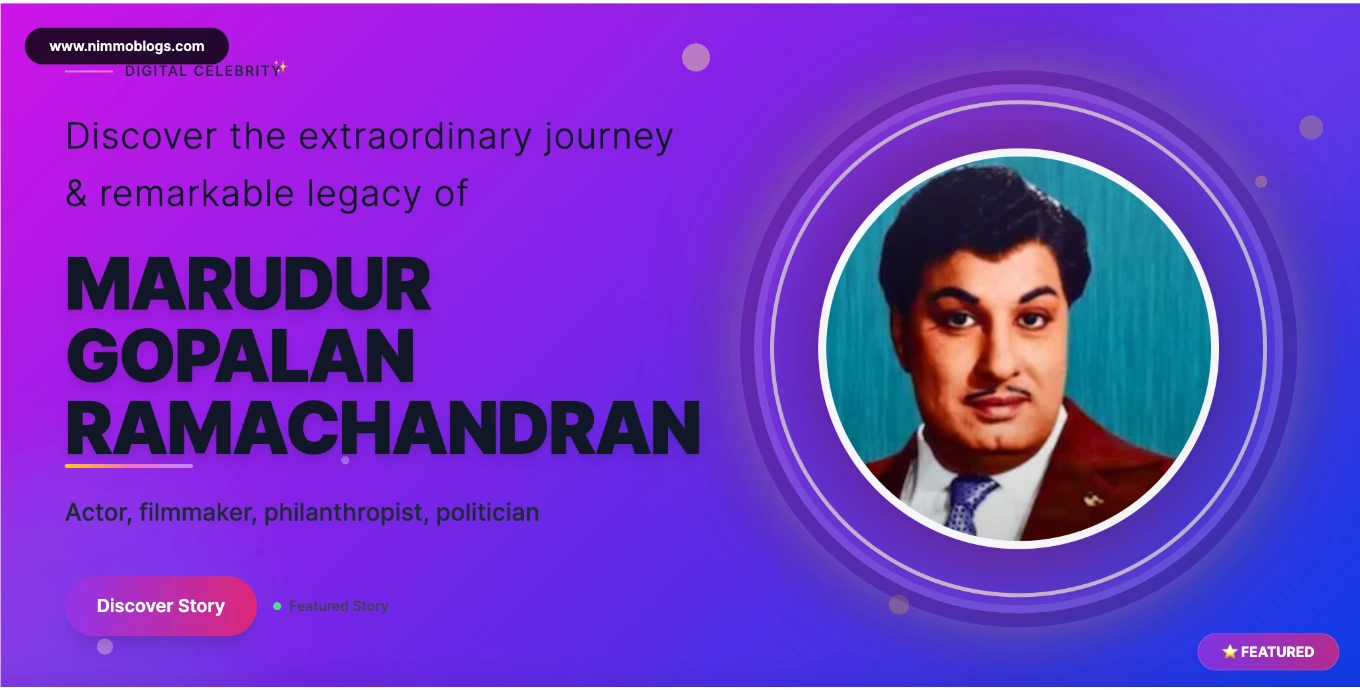
M. G. Ramachandran (1917–1987), known as MGR, stands as Tamil cinema's most politically influential superstar and one of India's most transformative political leaders. Honored as Makkal Thilagam (People's King) and Puratchi Thalaivar (Revolutionary Leader), he commanded unprecedented mass devotion, parlaying cinematic stardom into three consecutive terms as Chief Minister of Tamil Nadu (1977–1987).
From humble beginnings in Ceylon (present-day Sri Lanka) to dominating Tamil cinema with over 130 films—starring in blockbusters like Malaikkallan, Nadodi Mannan, Enga Veetu Pillai, Adimai Penn, and winning the National Film Award for Rickshawkaran—MGR revolutionized how cinema could articulate political and social ideologies. His governance expanded welfare schemes, introduced innovative nutrition programs, and championed women's education and mobility.
A recipient of the Bharat Ratna (1988, posthumously), MGR's legacy transcends entertainment, embodying the fusion of popular cinema and democratic politics. Explore his complete biography, theatrical origins, film career, political revolution, welfare initiatives, controversies, and 2025 commemorations honoring his extraordinary life.
Quick Info Table
| Real Name | Marudur Gopalan Ramachandran |
|---|---|
| Professional Name | M. G. Ramachandran (MGR) |
| Honorific Titles | Makkal Thilagam (People's King); Puratchi Thalaivar (Revolutionary Leader) |
| Date of Birth | January 17, 1917 |
| Date of Death | December 24, 1987 (Age 70) |
| Birthplace | Nawalapitiya, Kandy, British Ceylon (present-day Sri Lanka) |
| Height | 5'4" (162 cm) |
| Weight | 154 lbs (70 kg approx.) |
| Net Worth | Significant film earnings, studio ownership, real estate; extensive philanthropy |
| Marital Status | Married (three marriages); Final spouse: V. N. Janaki (actress) |
| Children | One documented familial association (Sudha Vijayakumar) |
| Nationality | Indian |
| Religion | Hinduism; later rationalist political alignment |
| Total Films | 130+ across Tamil, Telugu, Kannada cinema |
| Political Career | Chief Minister of Tamil Nadu (July 1977 – December 1987) |
Table of Contents
- Biography & Makkal Thilagam Legacy
- Early Life & Ceylon Origins
- Personal Life & Family
- Career Journey & Film Stardom
- Net Worth & Financial Success
- Movies & Landmark Filmography
- Physical Appearance & Screen Presence
- Awards & Major Recognitions
- Political Career & AIADMK Revolution
- Welfare Governance & Chief Minister Era
- Controversies & Political Challenges
- Interesting Facts & Trivia
- Streaming Availability & Global Access
- Latest Updates 2025 & Commemorations
- Comprehensive FAQ (25 Questions)
- Related Tamil Cinema & Politics Articles
Biography & Makkal Thilagam Legacy
 |
M. G. Ramachandran represents a unique historical phenomenon: complete fusion of mass cinema and democratic politics. His life trajectory—from impoverished stage performer to cinema megastar to democratic leader—embodied the aspirational narrative that Tamil cinema repeatedly celebrated. Unlike actors who dabbled in politics, MGR weaponized his cinematic persona for sustained political dominance, essentially making himself the embodiment of his own screen characters.
His screen persona—the righteous protagonist fighting systemic injustice, championing the underdog, redistributing wealth to the poor—seamlessly transitioned into political ideology. Audiences viewed him not as an actor playing roles but as an authentic voice of their aspirations. This conflation of reel and real proved electorally decisive: three consecutive landslide victories established AIADMK as Tamil Nadu's dominant political force, displacing the previously powerful DMK.
His governance reflected cinematic idealism: welfare expansion, nutritious meals for schoolchildren, subsidized bus tickets for women, and accessible cinema tickets for seniors. These weren't technocratic policies but populist gestures directly borrowed from his film scripts—transforming cinema's fantasy into governmental reality. For Tamil Nadu's working classes, this represented unprecedented alignment between their entertainment fantasies and lived political reality.
Early Life & Ceylon Origins (1917–1936)
Birth & Family Background
Marudur Gopalan Ramachandran was born on January 17, 1917, in Nawalapitiya, Kandy, British Ceylon (present-day Sri Lanka), to Malayali parents Melakkath Gopala Menon and Maruthur Satyabhama. His father worked in Ceylon's colonial administration; his mother came from a merchant family. His birth in Ceylon rather than Tamil Nadu would later become a paradoxical element of his Tamil political identity—he became Tamil Nadu's political icon despite being born outside the state.
His childhood was marked by poverty and displacement. His father's death in MGR's early years left the family financially vulnerable. His mother struggled to support children amid colonial Ceylon's economic precarity. This poverty—which would become a recurring theme in his film narratives—shaped his lifelong identification with the working classes and marginalized populations.
Theatre Origins & Formative Training
Rather than formal education, MGR received practical training through theatre. He joined the ' Original Boys' drama troupe as a youth performer, learning stagecraft through daily performances rather than classroom instruction. Theatre—with its immediate audience feedback, demanding physical presence, and requirement for emotional authenticity—became his academy. This background distinguished him from hereditary film actors: he earned his performative credentials through grueling stage work.
His stage performances in mythological and social dramas across Ceylon and later Tamil Nadu honed his ability to communicate with working-class audiences. Theatre audiences—often comprising laborers, merchants, and agricultural workers—demanded accessible storytelling and emotional directness. These skills proved invaluable to his later political career, where mass address and emotional connection became electoral currency.
Personal Life & Family Dynamics
Marriages & Spousal Relationships
MGR's personal life involved three marriages, reflecting complex relationship dynamics. His first wife was Bargavi (also known as Thangamani), with whom he had limited documented relationship details. His second marriage to Sathanandavathi ended with her death from tuberculosis—a loss that reportedly influenced his later public health advocacy.
His third and most significant marriage was to V. N. Janaki, a respected actress in her own right. Unlike his previous marriages, this partnership was both personal and political: Janaki became MGR's trusted advisor during his political years. After his death, she briefly served as Chief Minister of Tamil Nadu, demonstrating the legitimacy her association with MGR conferred. Their relationship spanned decades and produced the most documented partnership of his life.
Children & Family Legacy
MGR fathered limited documented children, with Sudha Vijayakumar representing the most publicly documented familial association. Unlike typical Bollywood dynasties, where children inherit film industry positions, MGR's children largely remained outside the public limelight, suggesting deliberate privacy maintenance. His political succession—Janaki's brief tenure as Chief Minister—highlighted that his political legacy was institutionalized through AIADMK rather than familial succession.
His relationship with his brother M. G. Chakrapani was professionally significant: Chakrapani also pursued acting and collaborated with MGR on several projects, though remaining less famous than his younger brother. The sibling relationship reflected MGR's pattern of elevating associates rather than competing with peers.
Career Journey & Cinema Stardom (1936–1977)
Film Debut & Early Career
| Film Career Timeline | |
|---|---|
| First Film Appearance | Sathi Leelavathi (1936) – Supporting role; directed by Ellis Dungan |
| Early Career | 1936–1950 – Supporting and minor roles; gradual prominence |
| Breakthrough Lead | Rajakumaari (1947) – First significant lead role |
| Major Stardom | Malaikkallan (1954) – President's Silver Medal; established superstardom |
| Peak Years | 1954–1977 – Consistent blockbusters; producer-director roles |
| Films as Actor-Producer-Director | Nadodi Mannan (1958), Ulagam Sutrum Valiban (1973) – creative control |
MGR's film debut came in Sathi Leelavathi (1936) in a minor supporting role. Progress was gradual through the 1940s, with meaningful breakthroughs arriving with Rajakumaari (1947). However, superstardom crystallized with Malaikkallan (1954)—a film so successful that it earned a President's Silver Medal and established MGR as Tamil cinema's leading action hero. The film's success validated his box office appeal and narrative preference for righteous protagonists challenging injustice.
His filmography from 1954–1977 demonstrates strategic consistency: Alibabavum 40 Thirudargalum (1955), Nadodi Mannan (1958, which he also produced and directed), Enga Veetu Pillai (1965), Adimai Penn (1969), and Rickshawkaran (1971) all centered on heroic protagonists triumphing through courage and moral integrity. These narratives—emphasizing distributive justice, protection of the vulnerable, and defiance of systemic oppression—directly mirrored his emerging political ideology and eventually his governance policies.
National Film Award & Artistic Recognition
Rickshawkaran (1971) earned MGR the National Film Award for Best Actor—cinema's highest acting honor. This social drama, depicting a rickshaw-puller's struggles and eventual triumph, showcased his mature acting abilities and thematic commitment to working-class narratives. The award represented peak artistic recognition, validating that his commercial popularity rested on legitimate performance talent rather than star charisma alone.
Net Worth & Financial Success (1950s–1987)
MGR's exact net worth at his 1987 death remains undisclosed. However, based on his prolific film career (130+ films), leading-actor remunerations during Tamil cinema's golden age (1950s–1970s), studio ownership (Sathya Studios, Emgeeyar Pictures), substantial real estate holdings in Chennai, and documented investments, estimates suggest accumulated wealth of ₹20–40 crores+ (approximately $2.5–5M USD) by his death—exceptionally significant for an Indian actor of that era.
 |
| Income Source | Estimated Contribution |
|---|---|
| Per-Film Acting Fee (1960s–1970s) | ₹2–5 lakhs per film (among the highest-paid actors) |
| Annual Income (Peak Years) | ₹30–60 lakhs+ annually (prolific output + production revenue) |
| Studio Ownership (Sathya Studios, Emgeeyar Pictures) | Significant backend revenues from produced films |
| Real Estate Investments | Multiple properties in Chennai, Madras region |
| Production & Direction | Creative control films (higher profit margins) |
| Cross-Language Films (Telugu, Kannada) | Premium fees for pan-Indian releases |
| Ministerial Salary (1977–1987) | Governmental position compensation |
His financial strategy combined film earnings with studio ownership—a rare achievement among actors of that era. Rather than dissipating wealth through conspicuous consumption, MGR reinvested in production ventures and real estate, building sustainable financial infrastructure. His studios—Sathya Studios and Emgeeyar Pictures—produced multiple films and supported charitable causes alongside commercial operations.
Movies & Landmark Filmography (130+ Films)
Complete Career Filmography Overview
MGR's filmography spans 130+ theatrical films across Tamil, Telugu, and Kannada cinema from 1936–1977. His film career effectively concluded upon his 1977 Chief Minister appointment, reflecting his total political commitment. His films demonstrate consistent thematic preoccupation: righteous protagonists battling injustice, redistributing wealth to the poor, protecting vulnerable populations, and ultimately triumphing through moral courage rather than corrupt compromise.
| Film | Year | Role/Significance | Achievement |
|---|---|---|---|
| Sathi Leelavathi | 1936 | Supporting role | Film debut |
| Marmayogi | 1951 | Lead; mythic thriller | Popular success |
| Malaikkallan | 1954 | Lead; action-hero | President's Silver Medal; breakthrough |
| Alibabavum 40 Thirudargalum | 1955 | Lead; adventure | Geva color technology; classic |
| Nadodi Mannan | 1958 | Lead; producer-director | Blockbuster; political allegory |
| Enga Veetu Pillai | 1965 | Lead (dual role) | Mass hit; Filmfare Special Award |
| Adimai Penn | 1969 | Lead; producer | Filmfare Best Film (Tamil); period drama |
| Rickshawkaran | 1971 | Lead; social drama | National Film Award Best Actor |
| Ulagam Sutrum Valiban | 1973 | Lead; producer-director | International locales; cult classic |
| Indru Pol Endrum Vazhga | 1977 | Lead; motivational | Late-career hit before politics |
His filmography displays remarkable consistency in narrative structure: MGR's characters typically began as underdogs—rickshaw-pullers, laborers, wronged innocents—who triumphed through integrity, courage, and moral clarity. This formulaic consistency paradoxically strengthened his political brand: audiences recognized his screen values as authentic expressions of his worldview rather than mere performance.
Physical Appearance & Distinctive Screen Presence
Physical Statistics
| Height | 5'4" (162 cm) |
|---|---|
| Weight | 154 lbs (70 kg approx.) |
| Body Type | Compact, athletic build |
| Eye Color | Dark Brown |
| Hair Color | Black (grayed later) |
| Complexion | Wheatish, distinctive features |
| Distinctive Features | Piercing eyes, resonant voice, commanding presence |
Screen Presence & Physical Impact
MGR's physical presence—despite relatively modest height—conveyed commanding authority. Unlike contemporary actors relying on towering frames, his power derived from intensity and conviction. His eyes—dark, penetrating, and emotionally expressive—became his signature screen feature. Directors specifically cast him for roles requiring moral authority: he needed to embody righteousness, not merely handsomeness.
His voice, trained through theatre, carried a distinctive resonance. Unlike actors dependent on playback singers, MGR's dialogue delivery—gravelly, powerful, and emotionally textured—became instantly recognizable. A 1967 shooting incident (when actor M. R. Radha fired at him) permanently damaged his hearing and voice, yet he continued performing and later his political career, demonstrating extraordinary resilience.
His movement vocabulary blended theatrical training with film aesthetics: economical but expressive, every gesture conveying psychological intention. This physical literacy enabled him to communicate complex emotions without relying on vocal emphasis, making him effective even in heavily dubbed Hindi and Telugu versions of his films.
Awards & Major Recognitions
MGR received significant honors across cinematic and civic platforms, validating his artistic contributions and political leadership.
| Year | Award | Category/Film | Recognizing Body | Significance |
|---|---|---|---|---|
| 1954 | President's Silver Medal | Malaikkallan | Government of India | Early cinematic recognition; breakthrough validation |
| 1965 | Filmfare Award – South | Special Award (Enga Veetu Pillai) | Industry | Industry recognition for mass appeal |
| 1969 | Filmfare Award – South | Best Film (Adimai Penn) | Industry | Production recognition |
| 1971 | National Film Award | Best Actor (Rickshawkaran) | Government of India | India's highest acting honor; artistic validation |
| 1974 | Honorary Doctorates | University of Madras; The World University (Arizona) | Academic institutions | Academic recognition for cultural impact |
| 1977 | Chief Minister Swearing-In | Political leadership | Tamil Nadu Government | Electoral mandate; political validation |
| 1988 | Bharat Ratna | India's highest civilian honor | Government of India | Posthumous recognition for lifetime contributions to cinema and public service |
The Bharat Ratna (1988, posthumous)—India's highest civilian honor—represented the culmination of his contributions. Presented after his death, it acknowledged both his cinematic achievements and transformative political leadership. This honor positioned him among India's immortal figures, equating his significance to independence leaders and national heroes.
 |
Political Career & AIADMK Revolution
DMK Association & Political Beginnings
MGR joined the Dravida Munnetra Kazhagam (DMK) in 1953, aligning with the party's rationalist ideology and Tamil linguistic nationalism. For nearly two decades, he served as DMK's cultural ambassador: his films articulated party ideology, his public appearances mobilized supporters, and his mass popularity enhanced DMK's electoral prospects. However, ideological friction and organizational conflicts gradually created tensions.
AIADMK Formation & Political Dominance
In 1972, MGR was expelled from DMK amid allegations of financial corruption. Rather than political retirement, he founded the All India Anna Dravida Munnetra Kazhagam (AIADMK)—a party explicitly designed around his personal political authority. AIADMK's founding ideology directly reflected its cinematic values: populist welfare, protection of the marginalized, women's dignity, and Tamil linguistic pride.
The 1977 state elections validated AIADMK's unprecedented success: MGR won a landslide victory on July 30, 1977, becoming Chief Minister at age 60. His three consecutive election victories (1977, 1980, 1984) established AIADMK as Tamil Nadu's dominant political force, displacing DMK and fundamentally reshaping South Indian politics. No other actor has achieved such sustained electoral dominance through direct personal leadership.
Governance & Chief Minister Welfare Initiatives (1977–1987)
Welfare-Driven Governance Philosophy
MGR's Chief Minister tenure (1977–1987) translated cinematic idealism into governmental reality. His administration prioritized welfare populism—direct redistribution to poor and working-class constituencies. Key initiatives included:
- Nutritious Noon-Meal Scheme: Massive expansion of free meals for schoolchildren, improving nutrition and school attendance, particularly among poor communities.
- Women's Mobility Initiatives: Subsidized bus fares for women; educational scholarships for girls; employment guarantees in government positions.
- Old-Age Pensions: Enhanced support for elderly citizens, particularly widows and destitute populations.
- Housing Programs: Land distribution and low-cost housing schemes targeting agricultural workers and laborers.
- Cinema Ticket Subsidies: Reduced ticket prices for senior citizens—a unique policy reflecting his film industry background.
- Agricultural Support: Loan forgiveness programs and input subsidies for small farmers.
Political & Social Impact
MGR's governance reflected populist principles rather than technocratic administration. His policies directly addressed working-class deprivation through visible, immediate welfare distribution. This approach—combining sentiment with redistribution—proved electorally decisive and established expectations for populist welfare that subsequent Tamil Nadu governments perpetuated.
Controversies & Political Challenges
1967 Shooting Incident
In August 1967, during the filming of Saravana Samayam, actor M. R. Radha shot MGR, injuring his left ear and permanently affecting his hearing and voice. The incident intensified political rivalry between DMK factions and became a pivotal moment in MGR's political trajectory. Public sympathy mobilized around him, and he leveraged the shooting as symbolic of systemic injustice—a narrative positioning that enhanced his political image as a persecuted truth-teller.
DMK Expulsion & Political Schism
His 1972 expulsion from DMK marked a critical turning point. Allegations of financial misappropriation—though never definitively resolved—precipitated his ouster. Rather than accepting political defeat, he transformed the expulsion into a founding narrative: positioned as the victim of bureaucratic corruption, he leveraged sympathy to launch AIADMK as a "clean alternative" to DMK's alleged organizational decay.
Health Decline & Administrative Challenges
By the mid-1980s, MGR's declining health—including diabetes complications and cardiac ailments—affected administrative capacity. Despite physical debilitation, he maintained political control through force of personality and institutional loyalty. His death on December 24, 1987, created a significant succession vacuum: his widow V. N. Janaki briefly assumed the Chief Minister position (1987–1988), though lacking his mass appeal.
Interesting Facts & Trivia
- Ceylon Origins: Born in British Ceylon (Sri Lanka), making him technically Sri Lankan by birth—a paradox for Tamil Nadu's supreme political leader.
- Theatre-to-Film Journey: Joined drama troupes at a young age; formal education was supplemented by practical stage training rather than college degrees.
- 1967 Shooting Survival: Survived a life-threatening gunshot wound inflicted by rival actor M. R. Radha; injury permanently affected hearing and voice, but couldn't diminish his appeal.
- Studio Owner: Established Sathya Studios and Emgeeyar Pictures, producing multiple films and supporting philanthropic causes.
- Three Marriages: Married three times across his lifetime, with his final marriage to actress V. N. Janaki lasting longest.
- 130+ Films: Appeared in over 130 films across Tamil, Telugu, and Kannada cinema—prolific output maintained over 41 years.
- National Film Award Winner: Won Best Actor for Rickshawkaran (1971), validating his artistic legitimacy alongside commercial success.
- AIADMK Founder: Founded AIADMK in 1972; the party became Tamil Nadu's dominant political force through his personal leadership.
- Three-Term Chief Minister: Served three consecutive terms (1977–1987), proving unparalleled electoral dominance in Tamil Nadu politics.
- Bharat Ratna Recipient: Honored with India's highest civilian honor posthumously (1988)—recognition of his dual cinema and political achievements.
- Chennai Central Renaming: In 2019, Chennai Central railway station was renamed Puratchi Thalaivar Dr. M. G. Ramachandran Central Railway Station.
- Welfare Legacy: Expanded nutritious noon-meal scheme, subsidized bus fares for women, and created pension schemes—policies continuing under subsequent governments.
Streaming Availability & Global Audience Access 2025
MGR's films are increasingly available through global streaming platforms, introducing contemporary audiences—particularly US diaspora communities—to his cinematic legacy:
| Platform | Available Films | Audience Target |
|---|---|---|
| Netflix | Select classics (Malaikkallan, Rickshawkaran, others) | Global + US diaspora |
| Amazon Prime Video | Extensive Tamil cinema archive | US subscribers; Indian diaspora |
| Disney+ Hotstar | Tamil and regional cinema classics | India + international subscribers |
| Zee5 | South Indian cinema archives | South India + diaspora |
| YouTube (Archival) | Restored and official channel releases | Global public; researchers |
For US audiences, MGR's films represent crucial historical documents: they demonstrate how cinema articulated populist political ideology and mobilized mass constituencies. His films—bridging entertainment and political propaganda—offer unique perspectives on cinema's political dimensions and the blurred boundaries between performance and reality in democratic contexts.
Latest Updates 2025 & Commemorations
2019 Chennai Central Railway Station Renaming
In April 2019, Chennai Central railway station was officially renamed Puratchi Thalaivar Dr. M. G. Ramachandran Central Railway Station, honoring his legacy. The renaming marked a significant civic recognition, positioning MGR among national figures worthy of permanent institutional commemoration. This renaming ensures his name remains visible to millions of daily commuters—a lasting tribute to his political significance.
Centenary Planning & 2017 Commemorations
His 100th birth anniversary (2017) witnessed renewed public interest, with film retrospectives, memorial events, and scholarly reevaluations. Organizations across Tamil Nadu organized festivals screening his classic films, introducing younger generations to his cinematic achievements and political philosophy.
 |
AIADMK Party Legacy & Ongoing Political Influence
The AIADMK—the party he founded in 1972—continues as Tamil Nadu's major political force in 2025. Though experiencing organizational divisions and leadership struggles since his death, the party's foundational commitment to welfare populism and Tamil nationalism remains rooted in MGR's original vision. His political ideology continues to shape Tamil Nadu's governance expectations.
Film Archive Restoration Projects
Film institutes and archival organizations have initiated restoration projects for his classic films, ensuring technical preservation alongside historical accessibility. Digital restorations of Rickshawkaran, Nadodi Mannan, and Ulagam Sutrum Valiban are underway, making his works available in contemporary formats for new audiences.
Academic Recognition & World Cinema Context
Contemporary film scholarship increasingly recognizes MGR as a foundational figure in cinema-politics studies. His unique fusion of mass entertainment and political leadership offers valuable case studies for understanding how cinema influences democratic politics, particularly in non-Western contexts. International film studies programs incorporate his films for analyzing populism, cinematic propaganda, and the actor-politician phenomenon.
Frequently Asked Questions (25 Questions)
Personal & Biographical
Q1: Who was M. G. Ramachandran (MGR)?
A: MGR (1917–1987) was a legendary Tamil cinema actor, filmmaker, and politician. Honored as Makkal Thilagam (People's King), he starred in 130+ films and served as Chief Minister of Tamil Nadu from 1977–1987, founding AIADMK. He received the Bharat Ratna posthumously.
Q2: When was MGR born and when did he die?
A: He was born on January 17, 1917, in Nawalapitiya, Kandy, British Ceylon (present-day Sri Lanka) and died on December 24, 1987, in Chennai from cardiac and respiratory ailments. He lived 70 years.
Q3: What is MGR's honorific title?
A: He's popularly known as Makkal Thilagam (People's King) and Puratchi Thalaivar (Revolutionary Leader) in Tamil Nadu. These titles reflect his mass appeal and political significance.
Q4: Where was MGR born?
A: He was born in Nawalapitiya, Kandy, British Ceylon (now Sri Lanka)—making him technically Sri Lankan by birth despite becoming Tamil Nadu's supreme political leader.
Q5: What was MGR's height and weight?
A: He stood 5'4" (162 cm) tall and weighed approximately 154 lbs (70 kg). Despite modest physical height, his screen presence conveyed commanding authority.
Q6: Who were MGR's parents?
A: His father was Melakkath Gopala Menon, and his mother was Maruthur Satyabhama. Both were Malayali; his father worked in Ceylon's colonial administration. MGR's father died early, leaving the family in financial hardship.
Q7: Was MGR married?
A: Yes, he married three times: first to Bargavi (also known as Thangamani), second to Sathanandavathi (who died of tuberculosis), and third to actress V. N. Janaki, with whom he remained until his death.
Career & Films
Q8: What was MGR's film debut?
A: His film debut was Sathi Leelavathi (1936) in a supporting role. His breakthrough lead came with Rajakumaari (1947), but superstardom crystallized with Malaikkallan (1954).
Q9: How many films did MGR act in?
A: He acted in over 130 films across Tamil, Telugu, and Kannada cinema from 1936–1977.
Q10: What are MGR's most famous films?
A: Major classics include Malaikkallan (1954), Alibabavum 40 Thirudargalum (1955), Nadodi Mannan (1958), Enga Veetu Pillai (1965), Adimai Penn (1969), and Rickshawkaran (1971).
Q11: Did MGR win any national awards?
A: Yes, he won the National Film Award for Best Actor for Rickshawkaran (1971). He also received the President's Silver Medal for Malaikkallan (1954) and multiple Filmfare Awards.
Q12: What made Rickshawkaran special?
A: Rickshawkaran (1971) earned MGR the National Film Award for Best Actor—India's highest acting honor. The social drama depicted a rickshaw-puller's struggles and triumph, showcasing his mature acting abilities.
Political Career
Q13: When did MGR become Chief Minister of Tamil Nadu?
A: He first took office on July 30, 1977, after AIADMK's landslide electoral victory. He served three consecutive terms until he died in 1987.
Q14: What party did MGR found?
A: He founded the AIADMK (All India Anna Dravida Munnetra Kazhagam) in 1972 after his expulsion from DMK. AIADMK became Tamil Nadu's dominant political force through its leadership.
Q15: How did MGR's Chief Minister tenure impact Tamil Nadu?
A: His governance expanded the nutritious noon-meal scheme, subsidized bus fares for women, enhanced old-age pensions, distributed land to agricultural workers, and created employment programs—establishing populist welfare as a governance model.
Awards & Legacy
Q16: Did MGR receive the Bharat Ratna?
A: Yes, he received the Bharat Ratna (India's highest civilian honor) in 1988, posthumously. The award recognized his lifetime contributions to cinema and public service.
Q17: What honors were conferred on MGR?
A: Major honors include Bharat Ratna (1988), National Film Award Best Actor (1971), President's Silver Medal (1954), multiple Filmfare Awards, and honorary doctorates from Indian and international universities.
Q18: Was Chennai Central railway station renamed after MGR?
A: Yes, in April 2019, it was renamed Puratchi Thalaivar Dr. M. G. Ramachandran Central Railway Station, honoring his legacy with a permanent civic tribute.
Family & Personal
Q19: Did MGR have children?
A: Limited documented children with public profiles; Sudha Vijayakumar represents the most publicly documented familial association. Unlike typical Bollywood dynasties, his children remained largely outside the public limelight.
Q20: Who succeeded MGR as Chief Minister?
A: His widow, V. N. Janaki (actress), briefly served as Chief Minister from 1987–1988, though lacking his mass political appeal. Leadership subsequently passed to other AIADMK figures.
Controversies & Personal
Q21: Was MGR shot?
A: Yes, in August 1967, actor M. R. Radha shot MGR during filming, injuring his left ear and permanently affecting his hearing and voice. The incident intensified political rivalry and became pivotal in his political trajectory.
Q22: Why was MGR expelled from DMK?
A: In 1972, he was expelled from DMK amid allegations of financial corruption. Rather than political retirement, he founded AIADMK, which became the dominant party in Tamil Nadu politics.
Modern Legacy & Streaming
Q23: Where can I watch MGR's films today?
A: His films are available on Netflix, Amazon Prime Video, Disney+ Hotstar, Zee5, and YouTube archival channels, with subtitles enabling global accessibility.
Q24: How is MGR remembered in 2025?
A: Through railway station renaming (2019), film retrospectives, memorial events, archive restoration projects, and academic recognition in world cinema studies. His political legacy continues to shape Tamil Nadu governance expectations.
Q25: What is MGR's most enduring legacy?
A: His fusion of mass cinema entertainment with democratic politics established that actors could achieve sustained electoral dominance through populist ideology. His welfare-driven governance model continues to influence Tamil Nadu policy, and his films remain studied for understanding cinema-politics dynamics.
 |
Related Articles
Explore the journeys of remarkable individuals who continue to inspire across industries and cultures with their unique contributions.
- Dulquer Salmaan Biography, Age, Net Worth, Height, Movies & Facts
- Gemini Ganesan Biography, Age, Net Worth, Height, Movies & Facts
- Shalini (Baby Shalini) Biography, Age, Net Worth & Movies
- Mammootty Biography, Age, Net Worth, Height, Movies & Awards
- Dulquer Salmaan Biography, Age, Net Worth & Movies
- Parvathy Thiruvothu Biography, Age, Net Worth, Height, Movies & Facts
- Prithviraj Sukumaran Biography, Age, Net Worth, Height, Movies & Facts
- Asin Thottumkal Biography, Age, Net Worth & Movies
- Dileep Biography, Age, Net Worth, Height, Movies & Facts
- Nivin Pauly Biography, Age, Net Worth, Height, Movies & Facts
- Amala Paul Biography: Age, Net Worth, Movies & Facts
- Vijay Deverakonda Biography, Age, Net Worth, Height, Movies & Facts
- Naga Chaitanya Biography, Age, Net Worth, Height & Movies
- Aruna Vijay Biography, Age, Career, MasterChef India & Facts
- Jahnavi Dasetty Biography, Age, Net Worth & Career
- Sadhique Aboobacker Biography, Age, Height, Instagram & Facts
- Madan Gowri Biography, Age, YouTube Channel, Net Worth & Facts
For comprehensive coverage of Tamil cinema and South Indian politics, visit our complete celebrities directory.

Goal Setting: How To Set Goal In Life

Podcast: How To Cancel Spotify Premium

Podcast: Podcast That Should Listen

Podcast: What Is Google Podcast
Podcast: What Is Podcast And How Does It Works

Time Management: Good Time Management Skills

Time Management: How To Improve Time Management Skills

Top 25 Ways To Increase Productivity
Robotics: What Is Robotics And How Does It Work

Positive Thoughts: Positive Thoughts Can Change Your Life

How To Become Rich With No Money

Top 5 Ways To Become A Rich

Communication: Top 7 Ways To Communicate Effectively

Personality Development Tips For Men

Personality Development Tips For Woman
©2026 Nimmoblogs
All Right Reserved.
Made with
 by Hina Aggarwal